Local Matters: Where You Live
- 4.9
- Rating
- 10.00K
- Installs
- Free
- Price

 Analysis by App-foxy
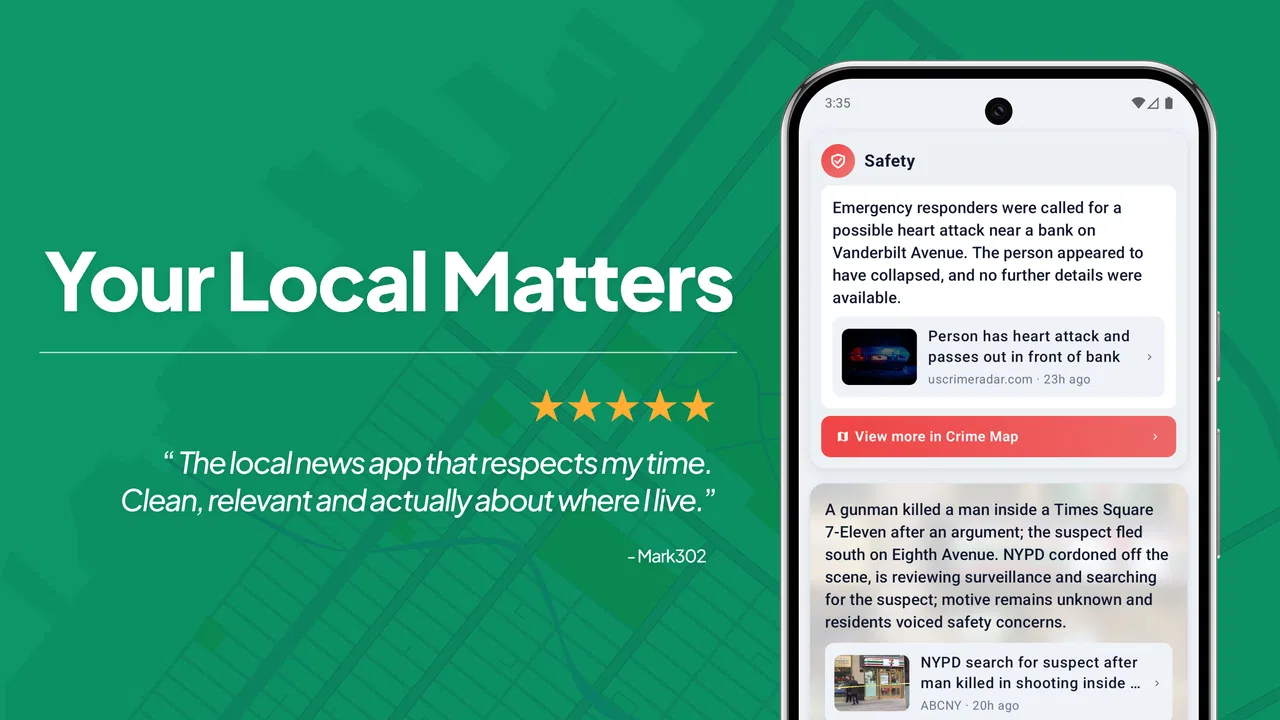
I approached Local Matters as a practical news and magazines app rather than another place to scroll endlessly. Its focus is close to home: safety alerts, nearby news, and weather presented around the user’s location and interests. That narrow purpose makes it easier to judge than a broad national news reader. The important question is not whether it can replace every source, but whether it helps me notice useful local information without creating extra work.
After spending time with it, my impression is that the concept is strongest for people who want a quick local check during the day. I can imagine opening it before leaving home, checking what may affect a route, and then moving on. It is also a reasonable fit for households where weather changes, neighborhood events, or safety information matter more than long opinion pieces. The app is free, aimed at Everyone, and developed by LifeAgents, so the barrier to trying it is low.
How Local Matters works for different readers and situations
I find the most useful way to judge Local Matters is by asking whether it turns nearby information into a better next decision, rather than whether it can replace a full news routine. That makes its value depend on the reader’s habits: a commuter may want a quick check before leaving, while someone with a quieter schedule may prefer to open it only when plans change. The same focused approach also brings tradeoffs, which are worth considering before deciding who will benefit most.
You May Also Like

 AccuWeather: Weather Radar
AccuWeather Review: A Quick, Clear Forecast for Everyday Decisions
For everyday plans, the best forecast is the one you can understand quickly. AccuWeather makes rain timing, radar, and local conditions easy to act on, with a few trade-offs.

 Hill Climb Racing
Why Hill Climb Racing Still Turns Crashes Into One More Run
A tiny car, a bumpy hill and one more upgrade: Hill Climb Racing keeps resurfacing because its simple chaos makes every near-miss feel personal.

 AliExpress - Shopping App
AliExpress Makes Global Shopping Feel Personal, but Shoppers Bear the Risk
AliExpress turns a global marketplace into a pocket-sized discovery engine. Its reach is useful, its shopping loop compelling, and its trade-offs easy to miss.

 Lords Mobile: Kingdom Wars
Lords Mobile Is a Kingdom-Building Routine, Not a Quick Match
A case-by-case verdict on the building, battles, device demands, and social commitments that make Lords Mobile rewarding for some players and exhausting for others.

 PDF Scanner app - TapScanner
TapScanner Makes Paperwork Easier to Capture, Check, and Share
TapScanner makes scanning with a phone feel less like a rescue operation and more like a dependable step in getting work done. Its capture tools are useful, though not flawless.

 Block Blast!
 Shows How Much a Puzzle Game Can Leave Out
A quiet grid game shows why puzzle players increasingly value instant clarity, repeatable skill and low-pressure play—and where the genre still needs to catch up.
More From Our News Desk
View All News


Readability and navigation for quick local checks
The app’s identity is clear from the first impression: it is built around the place where I live, not around a general stream of worldwide headlines. That distinction is useful. A traditional news app often asks me to filter through national stories before I reach something relevant to my street, town, or nearby area. Here, the local angle gives the experience a more immediate purpose.
I find this especially helpful when I have only a minute. A short visit can answer the practical questions I usually have in the morning: Is there a local alert worth knowing about? Has the weather changed? Is there a nearby story that could affect my plans? The personalized approach reduces the need to search manually, although it also means the usefulness depends on how well the chosen location and interests match my actual routine.
For readers who prefer plain, direct information, the format should feel more approachable than a dense newspaper homepage. Local news is often easier to understand when it is presented alongside the conditions people are dealing with that day. A weather update and a nearby alert can provide context that a general headline lacks.
There is a trade-off, though. Personalization can make a feed feel relevant, but it can also make the experience narrower than a conventional news reader. I would not use this as my only source for national or international coverage. My preferred workflow is to use it as a local layer, then turn to a broader publication when I want deeper reporting or a wider view.
One useful habit is to treat the opening check as a decision-making step rather than a reading session. I would scan the local items first, note anything that affects travel or plans, and avoid getting pulled into unrelated browsing. That approach suits people with limited attention, busy mornings, or difficulty processing a crowded collection of competing headlines.
The app’s current version is 1.9.4, which suggests an actively maintained product without making maintenance a reason to install it by itself. In practical terms, I would still judge each update by whether navigation remains predictable and whether important alerts remain easy to distinguish from ordinary local stories. For many users, consistency matters more than a long feature list.
Motor and sensory considerations in everyday use
A local information app can be valuable when it reduces the number of taps needed to reach relevant content. That matters for anyone who finds repeated scrolling, precise touch targets, or complicated menus tiring. The focused purpose of Local Matters gives it an advantage over broad apps that require several layers of navigation before showing anything useful.
For users with visual fatigue, the local-news format may also be easier to approach in short sessions. I would use it in brief checks instead of trying to read everything at once. The strongest accessibility benefit here is conceptual: relevant information is easier to handle than an enormous feed filled with topics I did not ask for.
At the same time, I would not assume that personalization automatically solves every accessibility need. People who rely on larger text, screen readers, magnification, speech input, or alternative controls should test the app on their own device. The practical experience can vary depending on the phone, operating system settings, and how the app presents its content. I appreciate the simple local focus, but I would not describe that alone as proof of comprehensive accessibility.
There is a useful sensory trade-off in safety information. Alerts can be important precisely because they interrupt normal routines, yet repeated or poorly prioritized notifications can become stressful. My advice is to decide how much interruption is genuinely helpful before relying on the app throughout the day. If I am already sensitive to notification overload, I would keep the app as a manual check rather than allowing every update to compete for attention.
For people with hearing loss, text-based local information can be more practical than depending on broadcast announcements, provided the relevant message is clearly written and easy to locate. For people with cognitive disabilities, the same local focus may reduce distraction, but unfamiliar place names, urgent wording, or several updates at once could still be difficult to process. I would read the most important item first and avoid treating every headline as equally urgent.
Motor limitations also change the best way to use the app. Someone who has difficulty holding a phone steady may prefer a planned check at a table rather than repeatedly opening it while walking. That is not a fault unique to this product; it is a sensible safety habit for any alert-based tool. The app is most helpful when it supports preparation, not when it encourages distracted phone use in the middle of a journey.
Situational access: when the local focus is most useful
The clearest everyday scenario for me is a morning commute. Before leaving, I would check the local feed and weather, then decide whether I need extra time, different clothing, or a change of route. The app does not need to replace a navigation service to be useful in that moment. Its value is in giving local context before I commit to a plan.
It can also help people who have recently moved and are still learning the rhythm of a new area. A neighborhood-focused feed may make local information feel less abstract than a national newspaper. I would use it to build awareness gradually, especially when I want to understand what kinds of events, conditions, and safety messages tend to matter nearby.
Families may find the combination of weather and safety information convenient when planning school runs, errands, or outdoor activities. Older adults who want local awareness without navigating a large general news platform may also appreciate the narrower purpose. However, I would encourage family members to help with initial setup if location choices or personalized preferences are confusing. Once the app is configured sensibly, the routine should be easier than searching multiple sources.
People who work irregular hours can use it differently. Instead of checking at breakfast, they might open it before a late shift or after sleeping during the day. That flexibility is important because local conditions do not follow everyone’s schedule. A quick review before going out can be more useful than a fixed morning ritual.
The app’s free price makes experimentation straightforward. I can try it alongside my existing news sources without first deciding whether it deserves a subscription. Its rating is a strong 4.8 average from around 117 ratings, and it has passed 10K installs, which indicates that other users have found the idea worthwhile. I treat those figures as encouraging rather than conclusive: a local app’s usefulness depends heavily on the quality and relevance of information in a particular area.
Location changes are another practical consideration for travelers, students, remote workers, and people who split time between homes. A personalized local service is most useful when it reflects where I actually need information today. If I were staying somewhere temporarily, I would check whether the app’s selected area can be adjusted easily and confirm that it is showing the place relevant to my plans before trusting the feed.
This is also where Local Matters differs from a weather-only app. Weather applications are usually better when I need detailed forecasts, while a broad news app is better for national coverage. Local Matters sits between those choices by combining nearby context with weather and safety awareness. That combination is its reason to exist, but it also means specialists may remain better for detailed forecasts, emergency guidance, or investigative reporting.
Remaining barriers and sensible limits
The biggest limitation is not the idea but the dependence on relevance. A local feed can feel extremely useful when it reflects my real surroundings and much less useful when stories are too broad, too repetitive, or not connected to my daily needs. I would give the app a fair trial during an ordinary week rather than judging it after one opening.
I also would not confuse a convenient alert feed with an official emergency channel. For serious safety decisions, I would follow instructions from the responsible local authorities and use established emergency services. Local Matters can help me notice information, but it should sit alongside—not replace—trusted official guidance.
Another barrier is the possibility of information arriving at the wrong moment. A person with anxiety, sensory sensitivity, or a demanding work environment may prefer fewer interruptions. The best setup for that user could be a deliberate, scheduled check. Someone who needs immediate awareness may choose a more active approach. The right balance is personal, and the app should be judged by whether it supports that choice without making the user feel constantly on duty.
Readers who want long articles, extensive archives, expert analysis, or a large international perspective should probably choose a full news platform first. Local Matters is not the app I would open for a deep investigation or a complete evening news briefing. Its strength is the small, practical question: what nearby information should influence my next decision?
People who dislike location-based personalization may also hesitate. The local focus is central to the experience, so anyone unwilling to tailor an app around where they live may find a manually searched news site more comfortable. In that case, the usual alternative offers more control at the cost of extra effort.
Device age can matter as well. The app requires Android 8.0 or later, so anyone using an older phone should check compatibility before planning around it. For supported devices, I would keep the operating system’s text and display settings comfortable, then evaluate whether the app remains readable at the size I need. A local service is only useful if I can access its information without strain.
Who should install it, and who should skip it?
I would recommend Local Matters to someone who wants a compact local briefing rather than another endless national feed. It makes sense for commuters, families, newcomers to an area, older readers seeking nearby awareness, and anyone who regularly checks weather before making plans. The free model also makes it a low-risk companion to an existing news routine.
I would be more cautious for readers who need detailed weather modeling, formal emergency instructions, or comprehensive journalism in one place. Those needs call for specialist tools or established news sources. I would also skip it if I rarely care about local updates or if notifications from information apps quickly become overwhelming.
My most useful tip is to define a simple purpose before using it: check nearby conditions, identify anything that changes today’s plans, and then close it. That keeps personalization working for me instead of turning into passive scrolling. A second tip is to compare its local information with the official source whenever an alert could affect safety. A third is to reassess the selected location after travel or a move, because a personalized feed is only as helpful as the context behind it.
An inclusive verdict on Local Matters
LifeAgents has made a focused news and magazines app that can fit naturally into short, practical routines. I like that it brings local awareness, weather, and safety into the same decision point instead of making me search several places. The experience is potentially less demanding than a broad news feed, which can help readers who value clarity, limited reading time, or a calmer information routine.
Its inclusive value is real but conditional. The local focus can reduce cognitive clutter, and short checks can suit different schedules and energy levels. Yet users with specific visual, motor, hearing, or sensory requirements should test how the app behaves with their own device settings. Personalization improves relevance, but it does not guarantee that every interaction will be accessible or comfortable.
With an Everyone content rating and a release date of December 18, 2025, it presents itself as a broadly approachable product. I would describe it as a useful local companion, not a universal news replacement. The best reason to install it is the combination of nearby awareness and everyday planning; the best reason to pass is needing deeper coverage or more specialized controls.
Overall, I would recommend giving it a place beside—not instead of—official alerts, detailed weather tools, and a trusted broader news source. If your main question is what may matter around you today, Local Matters is a sensible, free experiment. If your needs extend far beyond your immediate area, its focused design may feel limiting rather than liberating.
FAQs for Local Matters: Where You Live
01What is Local Matters: Where You Live?
Local Matters: Where You Live is a community-focused app designed to connect residents with local events, businesses, and news. The app provides a platform for users to explore what's happening in their neighborhood, find local deals, and engage with community initiatives. It's a great tool for staying informed and involved in your local area.
02Is Local Matters: Where You Live free to use?
Yes, Local Matters: Where You Live is free to download and use. However, certain features or events may require in-app purchases or subscriptions for premium content. Users can enjoy a wide range of free features, but should be aware of optional paid content that might enhance their experience.
03How does Local Matters ensure my privacy?
Local Matters takes user privacy seriously by implementing strong data protection measures. The app collects minimal personal information and employs encryption to keep your data secure. Users can customize their privacy settings to control what information is shared and with whom, ensuring a safe and private experience.
04Can I contribute content to Local Matters?
Yes, Local Matters encourages community involvement by allowing users to contribute content such as event listings, local news, and business reviews. This feature fosters a vibrant community atmosphere. Users can submit content through the app, subject to moderation to ensure accuracy and relevance.
05What platforms is Local Matters available on?
Local Matters is available on both Android and iOS platforms. Users can download the app from the Google Play Store or the Apple App Store. It is compatible with most modern smartphones and regularly updated to ensure smooth operation and access to the latest features.
Pros
- Intuitive interface makes navigation easy.
- Real-time local updates keep you informed.
- Customizable notifications for your area.
- User-friendly map integration for locations.
- Wide range of community events listed.
Cons
- Limited content in smaller towns.
- Occasional ads can be intrusive.
- Some features require premium access.
- May drain battery with background updates.
- Not all updates are consistently accurate.

Local Matters: Where You Live
Gallery